performance / Endurance
Mandala Chart
Turn one goal into eight focus areas and 64 actions with the method Shohei Ohtani used in high school. Start with the free printable template.
Download free 9×9 template
Photo: Gregory Shamus / Getty Images, via Harvard Gazette.
A Mandala Chart breaks one big goal into eight focus areas and up to 64 concrete actions. Put your goal in the middle of a 9×9 grid, surround it with eight things that support it, then give each of those things eight actions. Pick three to start this week.
That is the basic method Shohei Ohtani used in high school to connect a baseball ambition to specific behaviors. You can use the same structure for a race, a business, a creative project, or a year you want to approach with more direction.
How the Mandala Chart works
The full chart is nine 3×3 blocks arranged in a larger square. Start with the middle block and work outward.
- Center cell: Write your main goal here. Make it specific enough to recognize when you have achieved it.
- Center block: Fill the eight cells around your goal with supporting focus areas. These are the skills, habits, resources, or conditions your goal needs.
- Eight outer blocks: Copy each focus area into the middle of its matching outer block. Surround it with eight practical actions.
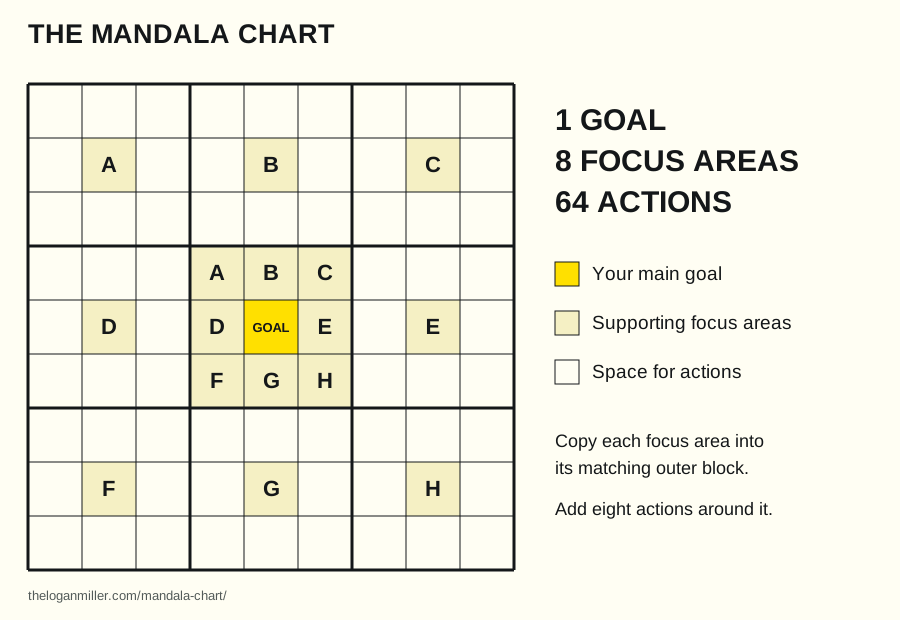
There are 81 cells, with space for 64 actions. The remaining cells hold your main goal and the eight focus areas, which each appear twice. You do not have to fill every action space before you begin.
How Shohei Ohtani used his goal chart
Before he became one of baseball’s greatest players, Ohtani used a goal chart in high school in Japan. His central ambition concerned becoming a top draft prospect. Around it, he mapped eight areas of development: physical conditioning, control, pitch sharpness, pitch velocity, breaking balls, mental strength, character, and luck. English translations of the labels vary. Harvard Gazette’s account of his goal-setting method describes how he connected those areas to daily behaviors.
The pitching categories make sense. The character and luck categories are what make the chart memorable.
Alongside athletic development, his chart included behaviors such as picking up litter, keeping his room clean, and showing respect to umpires. In that interview, Harvard Business School professor Frances X. Frei highlights how those choices connected his ambition with the person he wanted to become.
My takeaway: when you map a serious goal, include how you prepare, recover, learn, and treat people. Those areas deserve space beside the skill you are trying to improve.
The chart alone cannot explain Ohtani’s success. It does show a useful habit: taking a distant ambition and asking what it requires today.
How to fill out your Mandala Chart
1. Choose one clear goal
Write an outcome and a timeframe. For example: “Finish my first half marathon in six months.”
That gives the chart a job. “Get better at everything” gives you no clear way to choose between competing actions.
2. Name eight supporting focus areas
For the half-marathon goal, your center block could look like this:
| Running | Strength | Recovery |
|---|---|---|
| Fueling | Finish a half marathon in six months | Schedule |
| Mindset | Support | Race prep |
These are example categories, not a required formula. A business goal might need sales, delivery, cash flow, and customer feedback. A study goal might need practice, reading, revision, and a quieter workspace.
3. Expand each focus area into actions
Copy “Running” into the center of its outer block. Then write eight actions around it. For example:
- Choose a running plan that fits your starting point.
- Put the week’s runs on your calendar.
- Plan a route before each run.
- Lay out your running clothes the night before.
- Follow the effort targets in your plan.
- Log distance and effort after each run.
- Keep a backup route ready.
- Review next week’s sessions on Sunday.
Give each action a clear trigger or frequency where it helps. “Review my plan every Sunday after breakfast” tells you when to act. “Be more organized” leaves the decision for later.
Some entries will be daily habits; others will be weekly tasks or one-time decisions. A useful action can take five minutes or an hour. What matters is knowing what to do and when it is done.
4. Choose three actions for this week
The chart gives you options. Your calendar determines what you can actually do.
Start with three actions that address your biggest obstacle. Put them in your calendar, notebook, or existing task app. You do not need a new tool or 64 daily reminders.
If follow-through is your sticking point, Why I Run covers the small starting rule I use when I do not feel like heading out.
5. Review and adjust
Once a week, check what you completed, what got in the way, and what needs to change. Keep actions that help. Rewrite vague ones. Drop tasks that take time without moving you toward the goal.
The PDF includes a completed 64-action example so you can see how the outer blocks fit together. It illustrates planning, rather than prescribing a running program.
Other ways to use the chart
- New Year planner: Put your year or a yearly theme in the center. Use health, career, finances, relationships, learning, home, creativity, and contribution as possible focus areas. Give the outer actions dates or repeatable routines.
- Business project: Choose a launch or delivery target. Map the customer research, product work, budget, marketing, and support it needs.
- Learning a skill: Define a practical milestone. Build your chart around practice, feedback, study, projects, and opportunities to use the skill.
A yearly theme can organize several parts of your life. A specific goal makes it easier to decide whether an individual action belongs on the chart.
Common questions
Are Mandala Chart, Mandalart, and the Harada Method the same?
Goal-setting guides often use “Mandala Chart” and “Mandalart” for this grid format. Ohtani’s sheet is associated with the broader Harada Method, developed by Takashi Harada. The 64-action chart is one planning tool within that method; completing a grid is not the entire practice.
Do I need all 64 actions?
No. Leave spaces open if you do not yet know what belongs there. Start with useful actions, test them, and add detail as you learn. Filling boxes is not a measure of progress toward your goal.
How do I print the template?
Download the PDF and print in landscape orientation. It is laid out for US Letter; select fit to printable area for A4. Page one is the blank 9×9 chart, page two is the larger 3×3 starter, and page three is the completed example.
Start with one action today
Write the goal. Choose the eight things it depends on. Fill in the actions you can name now, then schedule three for the coming week.
Ohtani’s example gives you a useful question to keep asking: What can I do today that supports the goal in the middle?